
A common case that tests planning and communication
Consider a patient presenting with several missing posterior teeth, a few weakened abutments, and a request to avoid implants for now. The dentist has to decide between a cast metal framework, a flexible partial, or a combination design, all while accounting for future tooth loss and the patient's bite stability. This kind of case comes up regularly in general practices, and the outcome depends heavily on how well the clinical picture is communicated to the dental laboratory. At David Gelman's Dental Laboratory in Boca Raton, Florida, we work with referring dentists through exactly these scenarios every week, and this article walks through how proper planning, fabrication, and lab collaboration lead to a predictable, long-lasting removable partial denture.
Evaluating the case before any design decisions are made
Before a framework is designed, the lab needs a clear picture of the arch: the number and location of remaining teeth, the condition of abutment teeth, undercuts, ridge contours, and the opposing dentition. In a scenario like the one above, this means reviewing impressions or digital scans alongside the dentist's notes on mobility, periodontal status, and long-term prognosis of remaining teeth. Our CDT-certified technicians look closely at these details because a removable partial denture that is designed without this context often results in poor retention, uneven load distribution, or early framework fatigue. This is also the stage where decisions about rest seats, guide planes, and clasp placement begin to take shape, all of which depend on information the dentist provides during case submission.
Choosing between metal framework and flexible partial designs
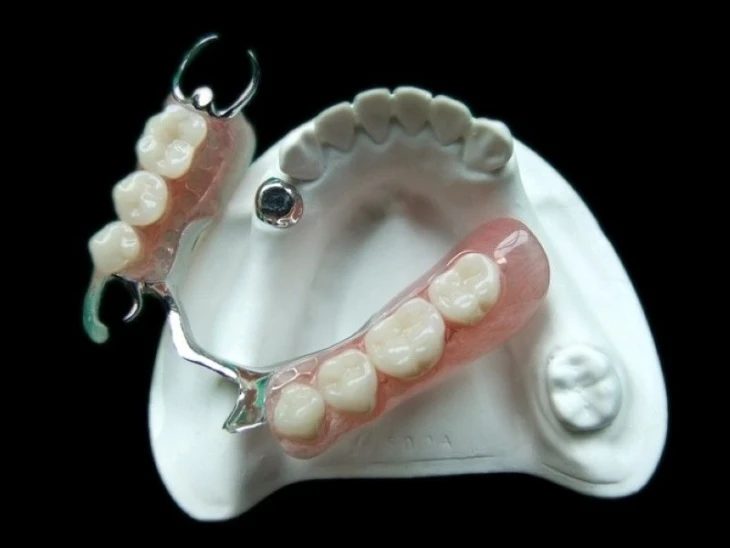
Once the clinical picture is clear, the next decision is material and design. A cast metal framework partial offers rigidity and precise, long-term fit, which is often preferable for patients with multiple missing teeth or where cross-arch stability matters. A flexible partial, by contrast, can be a reasonable option for smaller spans or patients who need a more adaptable, less rigid appliance, though it typically offers different retention characteristics. Neither option is universally better, and the right choice depends on the remaining dentition, the patient's bite forces, and the restorative plan for adjacent teeth. Our lab fabricates both metal framework and flexible partials entirely on premises, which allows us to discuss trade-offs directly with the referring dentist before fabrication begins rather than after a design has already been cast.
Fabrication steps that affect long-term fit and function
After the design is agreed upon, the framework or flexible base is fabricated with attention to the details that determine how the appliance performs over time. This includes precise clasp adaptation, correct relief over bony or soft tissue undercuts, and accurate occlusal relationships with the opposing arch. For patients in the Boca Raton area with more complex presentations, such as significant ridge resorption or uneven remaining dentition, our technicians apply proven techniques, including Dr. Joseph Massad methods and the BPS system where applicable, to maintain consistency and reduce the need for extensive chairside adjustment. Semi precision and precision attachments may also be incorporated when the case calls for improved retention or a more discreet clasp design, and these elements are planned and fabricated with the same level of detail as the framework itself.
Why clear communication between dentist and lab matters most
The outcome of a removable partial denture case often comes down to how well the dentist and lab communicate throughout the process, not just at the initial impression stage. Clear notes on tissue tolerance, remaining tooth prognosis, and patient expectations allow the lab to anticipate potential issues before fabrication rather than after delivery. When adjustments are needed, whether due to a shift in treatment plan or an unexpected clinical finding, ongoing dialogue between the practice and the lab helps keep the case on track. This collaborative approach is the same one we apply across our full range of removable prosthesis work, from full dentures to implant-supported hybrids, and it is especially relevant for partial denture cases where small design decisions have a meaningful impact on the final fit.
A predictable result starts with a well-planned case
Removable partial dentures remain a practical, well-established solution for many patients, but their long-term success depends on careful case evaluation, an appropriate material choice, and precise fabrication. For dentists practicing in and around Boca Raton, working with a lab that reviews each case thoroughly and communicates openly throughout the process helps reduce chairside adjustments and supports a more stable, comfortable outcome for the patient. Treating the partial denture as a collaborative case rather than a routine lab order tends to produce the most consistent results over time.
Frequently Asked Questions
What information should a dentist include when submitting a removable partial denture case to the lab?
Useful information includes accurate impressions or digital scans, notes on abutment tooth condition and mobility, the opposing arch relationship, and any relevant periodontal or restorative history. The more context the lab has, the more precisely the framework or flexible design can be planned.
How does a dentist decide between a metal framework and a flexible partial for a patient?
The decision generally depends on the number and location of missing teeth, the need for rigidity and cross-arch support, and the condition of remaining teeth. Metal frameworks typically offer more predictable long-term stability, while flexible partials can suit smaller spans or specific patient circumstances.
Does David Gelman's Dental Laboratory fabricate both metal and flexible partial dentures?
Yes, our lab in Boca Raton fabricates metal framework partials and flexible partials entirely on premises, allowing for direct collaboration with referring dentists on design decisions before and during fabrication.
Partner with our lab on your next removable partial denture case
Dentists in Boca Raton and the surrounding area can rely on our CDT-certified team for carefully planned, precisely fabricated removable partial dentures. Reach out to discuss case details and start a collaborative treatment plan for your next patient.