
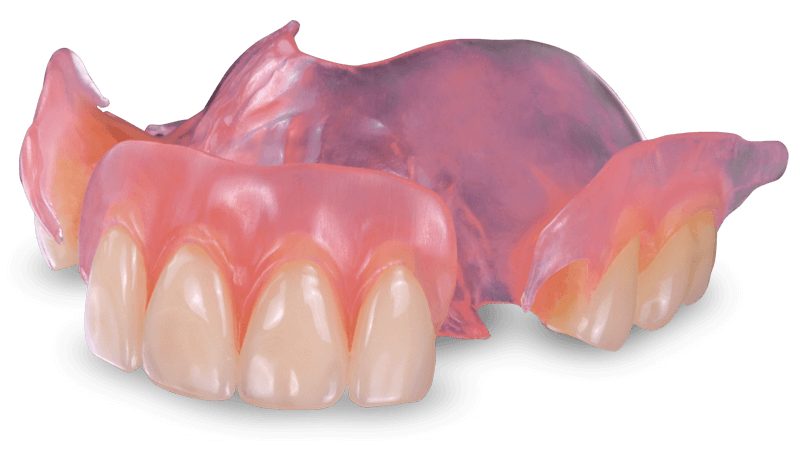
When a Partial Denture Case Demands More Than a Standard Approach
Consider a patient presenting with multiple missing teeth in a quadrant, limited budget for a cast metal framework, and a timeline that requires a reasonably quick turnaround. The dentist's instinct may be to order an acrylic partial denture, but the outcome of that case depends heavily on what happens at the laboratory level — not just at the chair. Acrylic partials are sometimes treated as a straightforward, low-complexity restoration, yet the decisions made during fabrication have a direct bearing on fit, function, and longevity. This article walks through the clinical and technical considerations that matter most when dentists in Boca Raton, FL, and the surrounding area are working with a dental laboratory on acrylic partial denture cases.
Understanding Where Acrylic Partials Fit in the Broader Prosthetic Picture
Acrylic partial dentures occupy a specific and legitimate place in the range of removable prostheses. They are commonly indicated as transitional or interim restorations, as immediate partials following extractions, or in cases where cost is a primary constraint for the patient. They differ from cast metal framework partials in that the base material is acrylic resin rather than a rigid cobalt-chromium alloy, which affects how load is distributed across the soft tissue and remaining dentition. Because acrylic partials rely more heavily on tissue support, the design of the base extension, the positioning of clasps, and the selection of denture teeth all carry significant clinical weight. A laboratory that understands these variables can help the prescribing dentist anticipate potential issues before the case is delivered, rather than after.
How Laboratory Design Decisions Affect Clinical Outcomes
The fabrication of an acrylic partial denture begins with the quality of the impression and the accuracy of the model, but the laboratory's role extends well beyond pouring stone. At David Gelman's Dental Laboratory in Boca Raton, FL, CDT-certified technicians evaluate each case for factors such as undercut depth, the condition of abutment teeth, and the span of the edentulous ridge. These assessments inform decisions about clasp wire gauge and placement, the thickness and contour of the acrylic base, and whether the case warrants a consultation with the prescribing dentist before fabrication proceeds. For cases involving significant bone loss or compromised ridge anatomy, these conversations are particularly important. A partial that looks acceptable on the model but fails to account for soft tissue compressibility or occlusal load distribution will create problems that are difficult to correct after delivery.
Acrylic Partials as Immediate and Transitional Restorations
One of the most common scenarios in which acrylic partials are prescribed is as an immediate restoration following planned extractions, or as a transitional appliance while a patient heals prior to implant placement or a definitive cast partial. In these situations, the laboratory must work with pre-extraction models and anticipate post-surgical tissue changes. The base design needs to allow for relining as the ridge resorbs, and the occlusion must be set with enough balance to function adequately without placing undue stress on healing tissues. David Gelman's Dental Laboratory performs relines and repairs on premises, which means that when a transitional acrylic partial requires adjustment as the patient's anatomy changes, the turnaround is handled within the same facility that fabricated the original appliance. This continuity supports consistent outcomes and reduces the variables introduced when cases move between multiple labs.
Communication Between the Dentist and the Laboratory
The quality of an acrylic partial denture is directly tied to the quality of the information exchanged between the prescribing dentist and the fabricating laboratory. A prescription that specifies only the missing teeth and the shade of the denture teeth leaves a significant number of design decisions to the technician's discretion. While experienced technicians can make sound default choices, the dentist's knowledge of the patient — including parafunction, opposing dentition, aesthetic expectations, and any history with previous removable appliances — is information that the laboratory cannot access from the model alone. Providing detailed case notes, photographs where relevant, and an open line for pre-fabrication questions leads to restorations that require fewer remakes and fewer chairside adjustments. At David Gelman's Dental Laboratory, the approach to every case is collaborative, with the understanding that the dentist and the laboratory each bring knowledge the other cannot fully replicate.
Acrylic Partials Deserve the Same Attention to Detail as Any Other Restoration
Acrylic partial dentures are sometimes underestimated as a category of restoration, but for the patients who depend on them, fit and function matter just as much as they do with any other prosthesis. The laboratory decisions made during fabrication — from base design to clasp placement to tooth selection — have lasting effects on how the appliance performs and how comfortable the patient remains over time. Dentists in Boca Raton and the surrounding region who partner with a laboratory that treats these cases with the same rigor applied to complex implant or crown-and-bridge work will see the difference in their outcomes. David Gelman's Dental Laboratory brings more than 35 years of hands-on experience and CDT-certified expertise to every removable prosthetic case, including acrylic partials at every level of complexity.
Frequently Asked Questions
What information should I include on the prescription when submitting an acrylic partial case?
Beyond the standard missing tooth notation and shade selection, it is helpful to include information about the patient's occlusion, any opposing removable appliances, the intended use of the partial (transitional versus long-term), and any known anatomical considerations such as significant undercuts or ridge irregularities. If the case involves immediate extractions, pre-extraction models and a clear note about the planned extraction sites will allow the laboratory to design the base appropriately.
How does an acrylic partial differ from a flexible partial, and when is each more appropriate?
An acrylic partial uses a rigid resin base with wire clasps, while a flexible partial uses a thermoplastic nylon material that conforms more closely to tissue contours and does not require metal clasps. Acrylic partials are generally easier to reline and repair, making them better suited for transitional use or cases where future adjustments are anticipated. Flexible partials are often preferred for aesthetic reasons or when patients have sensitivities to metal, but they have limitations in terms of adjustability and long-term dimensional stability. The appropriate choice depends on the patient's clinical situation, and the laboratory can provide guidance when the decision is not straightforward.
Can an acrylic partial be relined or repaired if the fit changes over time?
Yes. Relines and repairs are among the most common follow-up services for acrylic partial dentures, particularly those used as transitional restorations during ridge healing. David Gelman's Dental Laboratory performs relines and repairs entirely on premises in Boca Raton, FL, which allows for consistent quality and efficient turnaround. When submitting a case for reline, providing an accurate current impression and noting any changes in the patient's dentition or bite will help the laboratory achieve the best possible result.
Partner With a Laboratory That Treats Every Case With Precision
David Gelman's Dental Laboratory in Boca Raton, FL, brings CDT-certified expertise and more than 35 years of experience to acrylic partial dentures and the full range of removable prosthetic restorations. If you have a case you would like to discuss before submitting, or if you are looking for a laboratory partner that prioritizes clear communication and consistent outcomes, reach out to our team.